Diary/Learning Beyond Borders
I’m sorry to bother you, but I just wanted to say thank you for today’s session. It was truly inspiring and reminded me how important it is to take part in programs like this—not to rely solely on university studies. It truly made a difference for me, both personally and academically. I’m currently studying computer science at Astana IT University in Kazakhstan. But to be honest, I often feel quite lost about my future. After two years here, I’m expected to return to Afghanistan—and I really don’t want to. If I go back, everything I’ve worked so hard for over the past three years might be lost.Right now, life is very challenging. Financially, we live on about $70 per month, and we must cover everything ourselves—housing, food, transportation, health expenses, and our yearly visa renewals, which are quite expensive. I try to work on the side while studying because my family back home cannot support me.
I’ve also tried several times to find a job here, but since I only recently arrived and don’t yet speak the local language fluently, I haven’t been successful. I haven’t shared much of this with my family. We only speak once or twice a month, and when we do, I always try to sound fine. I know that if I tell them about my difficulties, they won’t be able to help—only worry. That’s why I’ve decided to keep these struggles to myself and focus on finding solutions alone. I hope that one day, even in silence, I can become someone strong—someone they can be proud of. One of my biggest dreams is to pursue a master’s degree in a country where I can truly grow, learn, and contribute. A major challenge for me is still my English, but I’m working on it every day and trying my best. Today, I felt that you truly understand Afghan people—especially Afghan girls. You were so kind and respectful to us, and it felt like I was speaking to a friend. That gave me the courage to open up and share this with you.
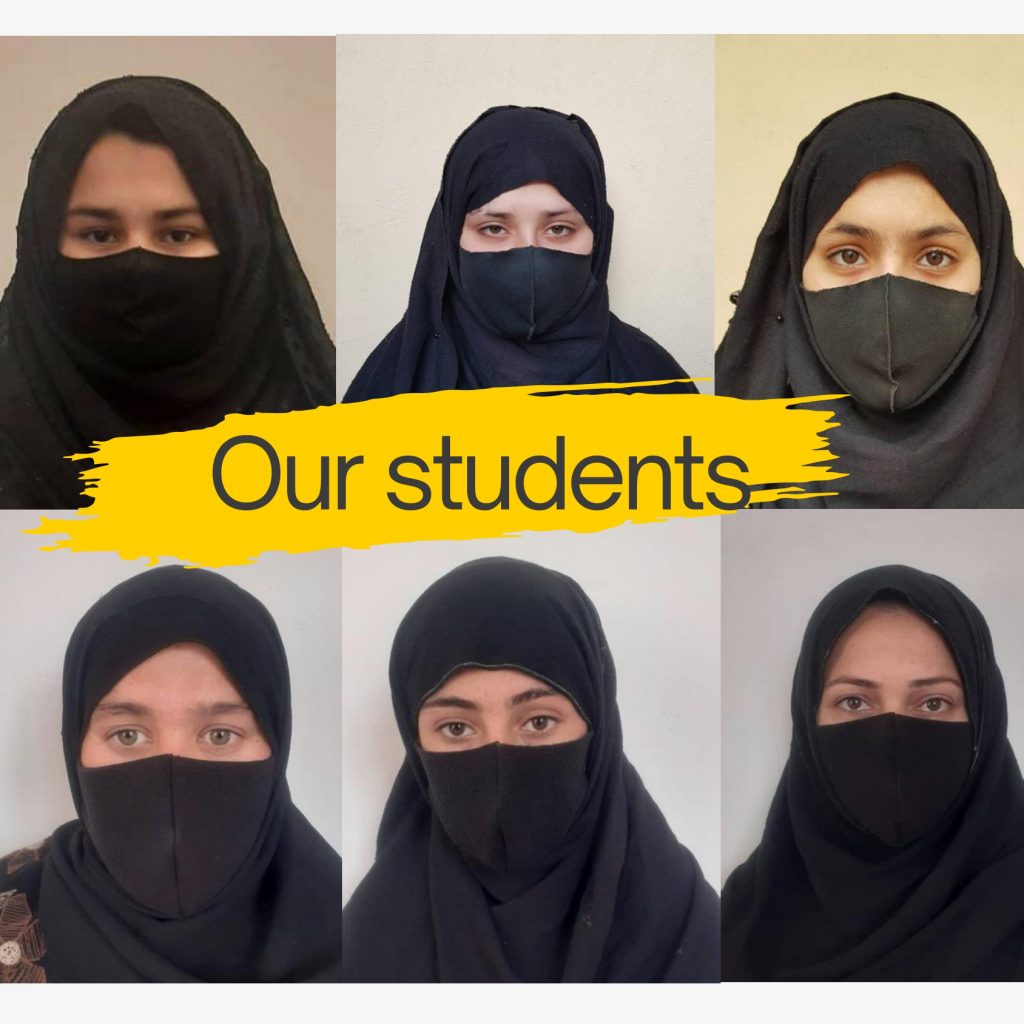
I come from a family of six sisters. During the last Taliban regime, my oldest sister couldn’t continue her education. Two of my younger sisters are now also not allowed to go to school. One of my sisters is studying medicine and economics in Almaty, and three of us are still continuing our education — despite all the obstacles. That means everything to us. Here in Kazakhstan, there are five of us Afghan girls, each carrying the same pain. It’s not just about academic struggles, but a wide range of other challenges. I can see it clearly — just by looking into their eyes. It’s as if their minds and hearts are in a constant battle, full of unspoken thoughts and silent worries. They rarely talk about what they’re going through, but somehow, we all share the same quiet determination: no matter how hard it gets, we want to become the heroes of our own chaotic and uncertain stories. And during this time, I’ve realized something powerful—that we Afghan girls carry a deep, shared pain, one the world hasn’t truly listened to. Even when we try to express it, it often goes unheard.
Since I arrived here, I’ve felt overwhelmed by everything — the academic pressure, the language barrier, the new culture, and the feeling of being completely alone. Sometimes, the only way I can express my thoughts and emotions is by talking to the trees and the tall buildings around me. It’s difficult to be in a city where everything is so developed and beautiful, while I remain trapped in my own pain and unable to see that beauty. Maybe this city really is a stranger to us—because my own city, Kabul, was destroyed and lonely, just like our hearts. Its walls were marked with fragments of shrapnel — the kind that killed thousands of young people and students in suicide attacks, tearing the hearts of mothers and fathers into pieces. Maybe that’s why I still feel that if I were in Afghanistan — even if I only spoke to the sky and walls of Kabul — I would be understood more.
But here, I feel that even the walls and sky do not listen — because they are not made of the same soul as ours. Even though the sky should be the same — the one that brings the sun and the hope of a new day — I don’t understand why I never feel peace here. I’ve sat next to the walls, beneath the sky of this city — but I’ve never felt comfort, never been able to calm my heart. Maybe I could have just written these words on paper and hidden them in a drawer — but I thought that by sharing them with you, I might lighten the weight on my shoulders, even just a little. Yesterday, something in your words was different. I felt seen again. And I thought — maybe I should write to you. Maybe if I write from the heart, you will understand. Because I felt that you truly listened to Afghan girls. Finally, I just want to say that I’m trying every day to make these new experiences look more beautiful in my mind — to see challenges as opportunities for growth. Even though my heart is shattered, I believe these moments will make me stronger, wiser, and one day, successful. Perhaps one day, I will even forget this pain.
So thank you again—from the bottom of my heart—for your time, your attention, and your kindness. If you have any advice for me, even the smallest piece, it would mean a lot.
Warm regards,
Sumia
Our Objectives

Goal 1: Promote equal access to education for all

Goal 2: Create safe and inclusive learning spaces that nurture curiosity and creativity

Goal 3: Foster respect for diversity, inclusion, and shared humanity in learning environments

Goal 4: Cultivate open-mindedness and cultural respect through education